|
|
|
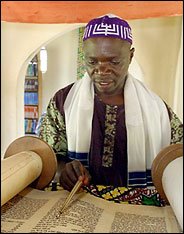
| Ugandan Jew also known as Abuyudaya |
By: Stephanie Comfort Jewish Historian,
Curator
Don
Noyes-More Ph.D. Content Editor
How does a religion, a race, or a way of life advance across a continent so dense and diverse
as Africa? At one time or another, Jewish merchants were present in every corner of the African land mass, literally seeding
small communities as they settled, sometimes permanently, to solidify their business connections. Jews did their share of
proselytizing, but unlike their Muslim and Christian fellows, Jews primarily spread their practices through intermarriage
and other forms of face-to-face cultural exchange. When Jews settled in an area they generally remained on the perimeter of
society, either due to their own desire to keep to themselves or the social and legal restrictions that others imposed. Judaism
crept across Africa slowly, from person to person, village to village, with communities springing up as Jews moved into a
region, then disappearing as the business climate changed or as Muslims or Christians swept in to force their own beliefs
on the local inhabitants.
Though the Jewish communities of North Africa
maintained contact with Jews elsewhere, most of the ancient Jews who dwelled in other parts of the continent left little or
no hard evidence of their existence. Most pre-19th century accounts of the Jews in sub-Saharan Africa come from wandering European
traders, explorers and historians. With little physical evidence to prove Jewish presence, these travelers based their assertions
that they had found descendants of the Hebrews on a mixture of observation and conjecture. They often identified "Jews" by
such arbitrary characteristics as facial structure (the "Semitic" nose, dense, "Mediterranean" eyebrows), choice of occupation
(merchant, banker, metalworker), and devotion to education or intellectual pursuit. Some explorers claimed to find such "evidence"
of Jewish populations in every nook of the African continent, leaving historians with muddled accounts through which they
are still sifting. The pre-19th century European
explorers who found Jews all over Africa could not verify their claims; modern "explorers" have not fared much better. When
contemporary ethnographers look for evidence of one culture’s influence on another they consider a wide variety of characteristics
and practices – dress, diet, rituals, theological belief. They compare the cultures’ legends, languages, art and
family structure, reveling in even the most arcane similarities between the two disparate peoples as evidence of their connection.
Researchers generally use a litmus test of basic Jewish beliefs and practices to determine the "Jewishness" of a community.
Do they worship one God, the researchers ask, or at least a single deity? Do they follow Jewish dietary laws that prohibit
them from eating certain animals and meat not slaughtered according to ritual? Do they observe Sabbath on Saturday? Does their
language share words or grammatical structure with Hebrew? Do they use traditional Jewish colors or symbols in their art?
If a community does have Jewish characteristics, one must further question the characteristics’ origins. Has the community
always held these beliefs or did they develop them after contact with Jewish visitors? Did Christian or Muslim proselytizers
bring monotheism and some rituals that, over the years, modified into practices that most would associate with Judaism? To complicate matters, the traditions of contemporary
Africans who call themselves Jews are exceptionally diverse; even Jews in the same geographic areas express their Judaism
in different ways. White South African Jews practice a familiar, European type of Judaism, replete with ornate synagogues
and traditional Jewish community organizations, while their black countrymen, the Lemba, live in thatch huts in mountain villages,
conjure the spirits of their ancestors during harvest festivals and practice secret rituals that induce their neighbors to
accuse them of sorcery. The Abayudaya in Uganda follow most of the Rabbinical holidays and traditions, while the Ethiopian
Jews take most of their rituals directly from the Old Testament. Having lived in virtual isolation on an island off the coast
of Tunisia, Jews of Djerba maintain most of the practices that their Jewish ancestors did when they landed there two thousand
years ago, while Moroccan Jewry has evolved over the centuries to encompass customs of the Christians, Muslims and Berbers. Identifying "Jewish" characteristics in a culture
is simple; affirming the Semitic origin of those similarities is much more difficult. Ethnography can yield educated guesses,
but anecdotal evidence can not prove a connection. In recent years, geneticists have eschewed cultural research and examined
the chromosomes of the community members in question to find traditionally Semitic gene mutations. Genetic research has shown
that the Southern African Lemba in fact share Semitic chromosomes, but even if geneticists find "Jewish" genes, they still
can not know exactly how those genes found their way into the Lemba population. If the Jews of Africa follow such different
traditions, speak such different languages, are different colors, shapes and sizes, even have different genetic patterns from
one another, how can they all conceivably consider themselves to be members of the same people? The one unifying characteristic of today’s African Jews
is that they are proud of their Judaism and their place within the people of Israel. They would like others to think that
they are Jewish, but no one has to convince them of their ancestry or their beliefs. Article based in part on Wikipedia The
Jews of Africa.
|