JANE-MARIE’S BIRTHDAY
By: Dr. Don Noyes-More Ph.D.
"Even with Cerebral Palsy Jane had a shining joy"
I have a very good friend who
lived in Altadena, California. His name is Callon. Altadena is a small
community pushed up against the foothills of the San Gabriel Mountains near
Pasadena. Callon was a tall, red-haired boy with a face full of freckles. He
was all muscle. I was 17 when Callon took me to meet Jane-Marie for the first
time. Jane-Marie was Callon’s cousin and was having a hard time with her
Cerebral Palsy. She was 16 years old. We drove up to a modest white house. We
walked in the open door. Raspy disconnected words came from an over stuffed
chair. It was Jane- Marie. She had long golden hair. She looked liked a poorly
put- together rag doll. Nothing worked. Her arms and legs all pointed in wrong
directions. She could not keep her head still and it bobbed back and forth. She
tried to speak but all that came out were half words or disconnected words.
Callon said he taught her a lot of swear words. Her family was not pleased with
that at all. But through it all there was a personal presence that was very
distinct. Jane-Marie through all her physical problems was able to make
personal contact with others through her very expressive eyes. Her eyes locked
onto me. The next thing I knew I was sitting next to her talking. Jane-Marie’s
mother walked in and seemed upset that I was there. Callon said, “Donnie, we
better be going.” I nodded. Jane-Marie was not happy we were leaving and made a
bit of a fuss. Her mother was waving us out of the room like we were some sort
of pests. Jane-Marie’s eyes followed me out the door. I waved at her and
smiled.
A few months later Callon phoned me
and said Jane-Marie was in the hospital for tests, and he was going by the
hospital to visit. “It’s Jane-Marie’s birthday so I really need to be there for
her. You want to come?” He said.
“Sure,” I replied. He picked me up an
hour later, and we were off to the hospital in Pasadena. On the way I picked up
a bright red clown doll for Jane-Marie. We went to the desk at the reception
area of the hospital and were told it was almost too late to visit. We ran to
the elevator and down a corridor to her room. We found Jane-Marie in a private
room with her radio blasting. She burst out with a “Hello.” One word she got
out without too much of a problem. We sat talking and Jane-Marie opened her
presents from us. A nurse came in and said visiting hours were over. We weren’t
happy with that news.
“It’s her birthday we need to celebrate. You
want to go out tonight Jane-Marie?” Callon asked.
Out came a long and distorted “Yes!”
from Jane-Marie.
“How we going to do that Callon?” I asked.
“We’ll leave a
note. And we’ll take Jane-Marie and go down the
stairs,” he answered.
“Wow, far out!”
I laughed. We got Jane-Marie dressed, wrote
the note that we were taking her to
get an ice cream, and then picked her up and ran for the staircase. Down the
stairs we flew with Jane-Marie being carried like a sack of potatoes. We were
all laughing. She was laughing very loudly. We got into the car and sped off
into the night. We got onto the old Pasadena freeway and aimed for Hollywood.
We headed for Sunset Blvd. with
Jane-Marie sitting between Callon and myself. Our first stop was Gino’s, an
under 21 club on Melrose Avenue. It was only 11:00 PM, early for the “after
hour” clubs. With Jane-Marie in our arms, we went in the club. The owner Pietro
was not happy and said we could stay only an hour. The music and lights were
loud and bright. I tied Jane-Marie’s scarf around her head thinking It made her
look cool. Callon and I decided to take her on the dance floor to boogie. Our
arms were under her arms, and we were all swaying to the music. It was a very
physical three-way dance. I saw two friends, Bill and James, came in the club.
They saw us and came over. I’m sure they were wondering what this was all about
from the surprised look on their faces when they saw us on the dance floor.
Callon filled them in on our birthday adventure with Jane-Marie. They smiled
and broke out into “Happy Birthday.” All the people there joined in, to the
delight of Jane-Marie. Everyone near us came over to give her a birthday kiss.
Bill and James said they wanted to join the party for the night. We said,
“Sure.” So we hopped into Callon’s car and drove back to Sunset Blvd. to The
Fifth Estate Coffee House. Jane-Marie was going to have a birthday she would
never forget.
At the Fifth Estate we walked into a
very smoky room filled with Hippie types. There was this well-known Hollywood
character guy named Gypsy reading weird poetry. He was a regular in the
Hollywood area – was even on TV a few times. We ordered espressos and asked for
a straw for Jane-Marie. Our server was not pleased by us being there and showed
it by a edge in her voice and manner. When we were served our coffees
Jane-Marie yelled out very clearly a “Fuck you” to our uptight server. We all
laughed. After a number of espressos we were duly wired. We were asked to leave
since we had now become too noisy for the other patrons intent on listening to
the long-winded, bad poetry, and political ramblings of Gypsy. “Now, where to?”
I asked James.
“How about Laguna Beach,” he said.
“Cool, let’s go.” I yelled.
It was 2 AM when we started our trek
to the beach. It was a warm night so we raced down the freeway with our windows
open and music blasting. The Beach Boys Good Vibrations was turned up
and we were all singing. Jane-Marie had a nonstop slanted smile that was
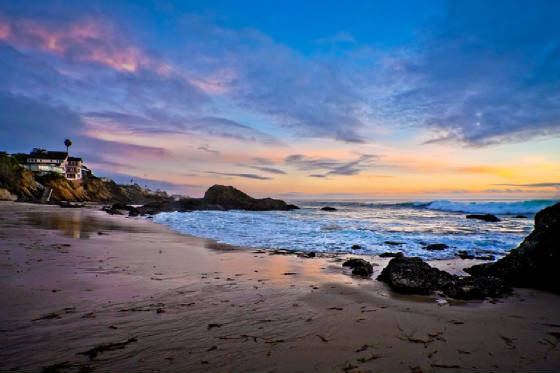
wonderful. We finally hit the beach about 3 AM. There was a small cove about a
half mile walk from the car. At the cove we found a lot of driftwood and built
a fire.
We were all squeezed together on a
large blanket from Callon’s special back seat kit when we decided to go
into the water. We stripped naked including Jane-Marie, and we headed for the
water. There was a bright moon out, and we were playing in the gentle waves.
Jane-Marie was laughing the hardest. We had to hold her up while in the water.
She was so excited her arms were all over the place, twice we got hit by a
flying left or right arm. One by one we finally tired and headed for the
blanket. We took turns drying off with the one beach towel. We settled on the
blanket, just watching the fire. I was combing Jane-Marie’s hair. The rest
tossed a ball back and forth and ended up wrestling in the sand. Jane- Marie’s
body for the first time started to slow and became less spastic. She put her
head on my shoulder, and I put my arm around her. She felt soft and warm. The
others were going to sleep but Jane-Marie and I sat there watching the flames.
It was dawn and Jane-Marie and I were
still awake. The others had fallen fast asleep. We looked at each other and
smiled. I picked her up and took her to the edge of the water. Arm and arm we
sat there until the sun was fully up. Jane-Marie turned her head and in broken
speech said, “tha...a..a...nk you. Ma.., ma.., my best birthday.” She glowed
warm and smelled sweet. We kissed.
With the bright sun, everyone woke
up. Callon called Jane- Marie’s mom and told her all that had happened. She was
very upset and told Callon to get Jane-Marie back to the hospital. She said she
would call off the police and tell them that a mistake had been made. Callon
was driving us all home. I was the last to be left off. Callon, Jane-Marie and
myself were in the car. Jane-Marie had long ago fallen asleep on my arm. I
lifted her up, and gave her a kiss. She was too asleep to even know what was
happening. Callon had a scared look on his face.
I sent cards and visited Jane-Marie,
but her mother was always present. There was no privacy. Jane-Maries’ life was
waning. She had less than a year to live. Her mother kept her away from almost
everyone but herself. I was not allowed to visit. I called once and
Jane-Marie’s mother was there, picked up the phone and hung up on me.
Jane-Marie died in the hospital. Her Aunt told me that Jane-Marie loved the red
clown doll I gave her. And it was always on her hospital bed. I’ve keep her
memory as part of a very special time in my life.